DeepLoop Team · 2026-07-27
Pig-House Air Quality: The One Limit Five Sources Agree On
Almost nothing in pig housing is fully settled - but the ammonia ceiling is. Five independent sources across five countries land on the same number. The harder problem is that most farms measure it in the one spot where it doesn't matter.
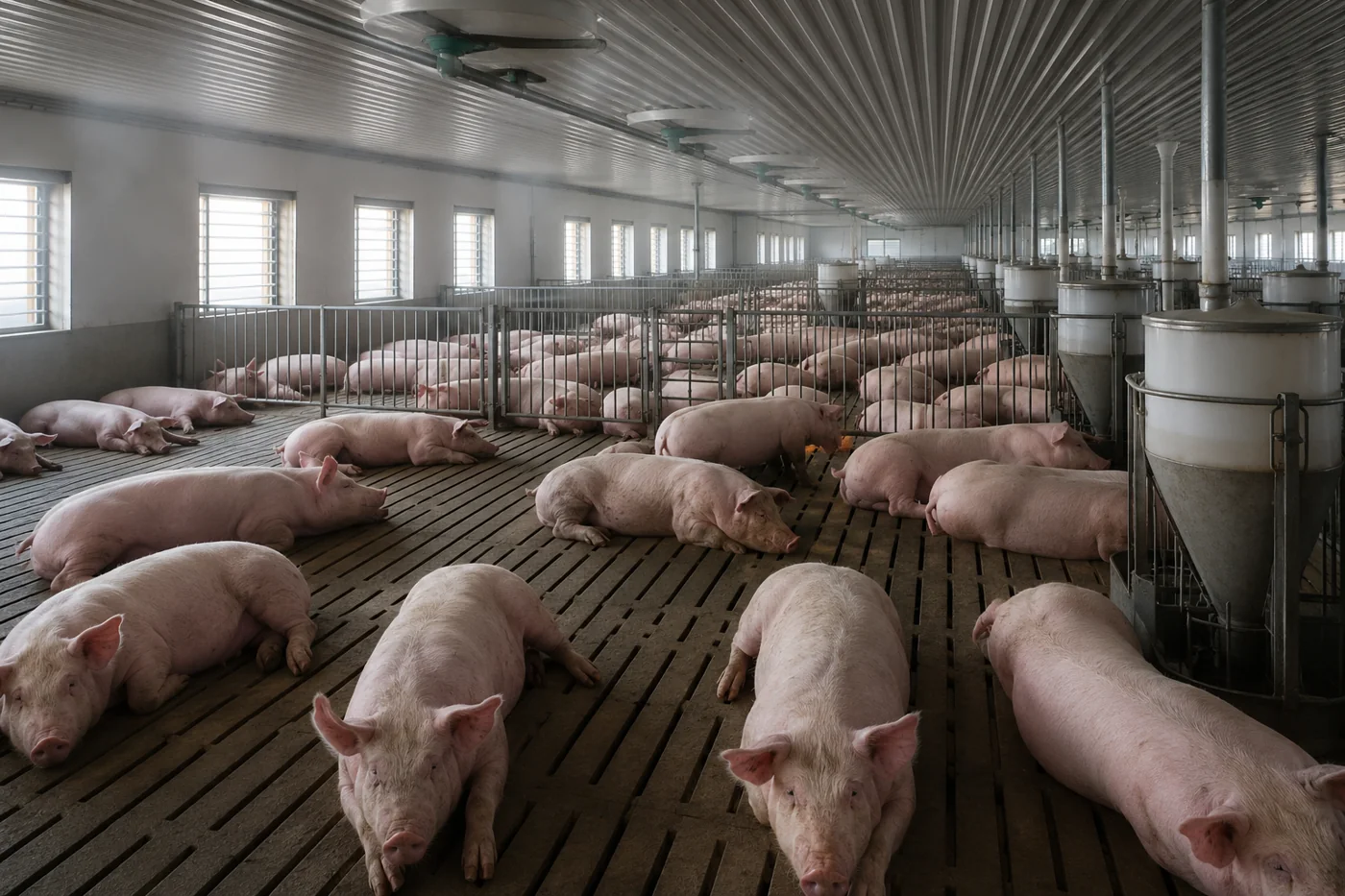
Five sources, one number
A Danish advisory body (SEGES, publishing the CIGR standard), two Dutch genetics companies (Topigs Norsvin, Hypor), an American breeder (PIC) and a Danish one (DanBred) all work from completely different research - and all land on the same ceiling: ammonia below 20 ppm, carbon dioxide below 3,000 ppm. That level of agreement is rare in pig housing, where almost everything else is contested. When five parties who share no methodology converge on one figure, it stops being an opinion and starts being a target worth holding.
Where the measurement goes wrong
The agreement on the number hides a problem with how it's checked. On most farms the controller's gas sensor sits at head height, over the inspection alley - the one place in the building with no pigs and no heat production. The pigs live 30 cm off the floor, under the covers, where the gas actually concentrates. SEGES is blunt about the fix: sit down at the back of the pen, where the pigs lie, and measure ammonia there - not just at the exhaust. The Dutch source adds one condition: measure with the animals at rest. A reading over the alley can look fine while the air the pigs breathe is well over the limit.
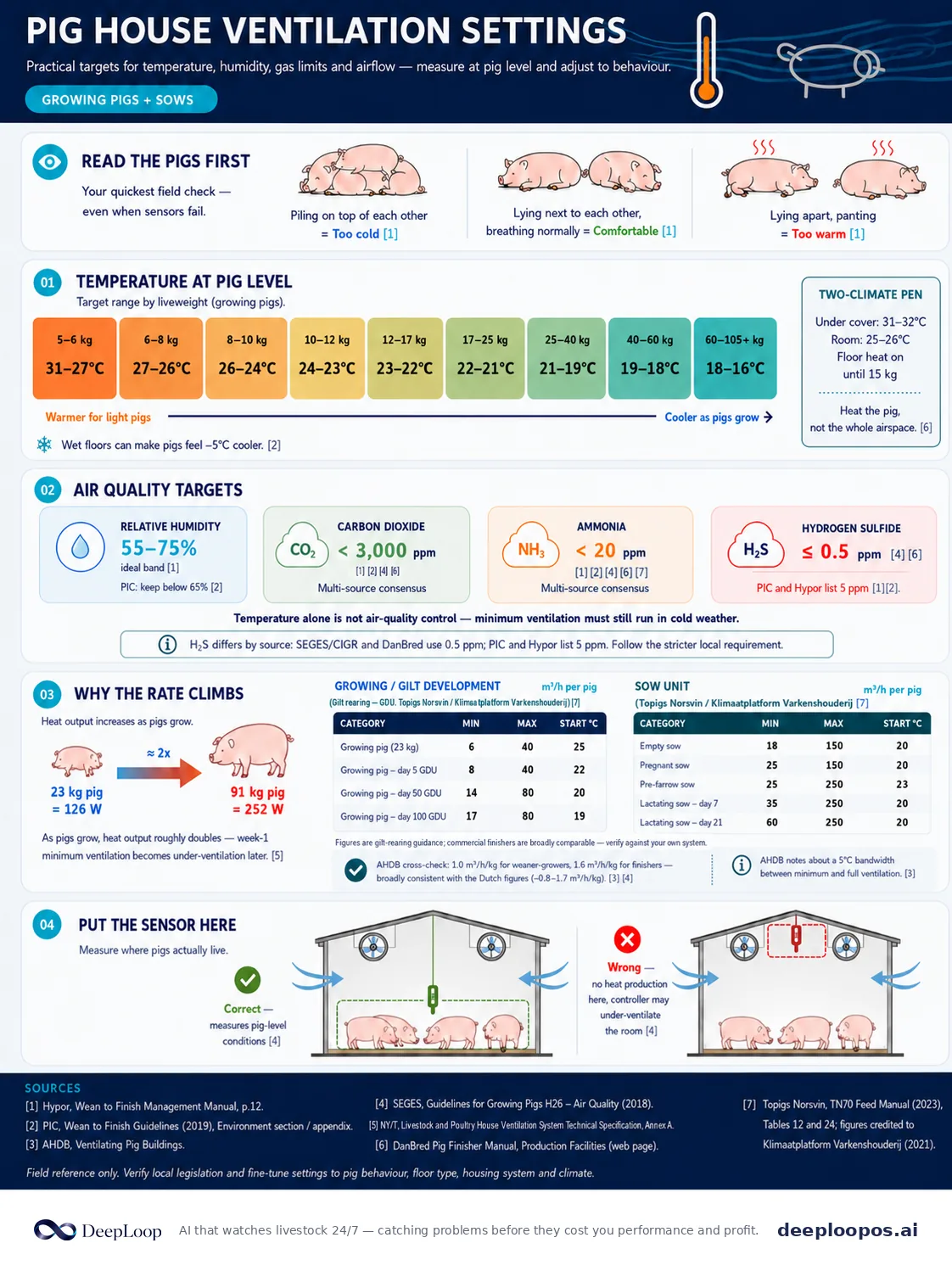
Ammonia and CO₂ ceilings, cross-checked across SEGES/CIGR (DK), Topigs Norsvin (NL), PIC (US), Hypor (NL) and DanBred (DK).
What the 2025 review actually found
A 2025 systematic review in Animals (Trabachini et al., CC BY 4.0) read 75 precision-livestock-farming studies on swine and reported where the technology really stands. Two findings are worth sitting with. On air: dust and ammonia interact to cause significant harm to pigs - environmental management has to be rigorous, not occasional. On the tools: across all 75 studies the authors conclude that monitoring systems still do not offer a complete multidimensional integration for a holistic assessment of welfare. Image analysis appeared in 10 studies, sensors and IoT in 5, and cameras were used as sensors in only 12% of the image-analysis work. Plenty of single signals; very little that combines them.
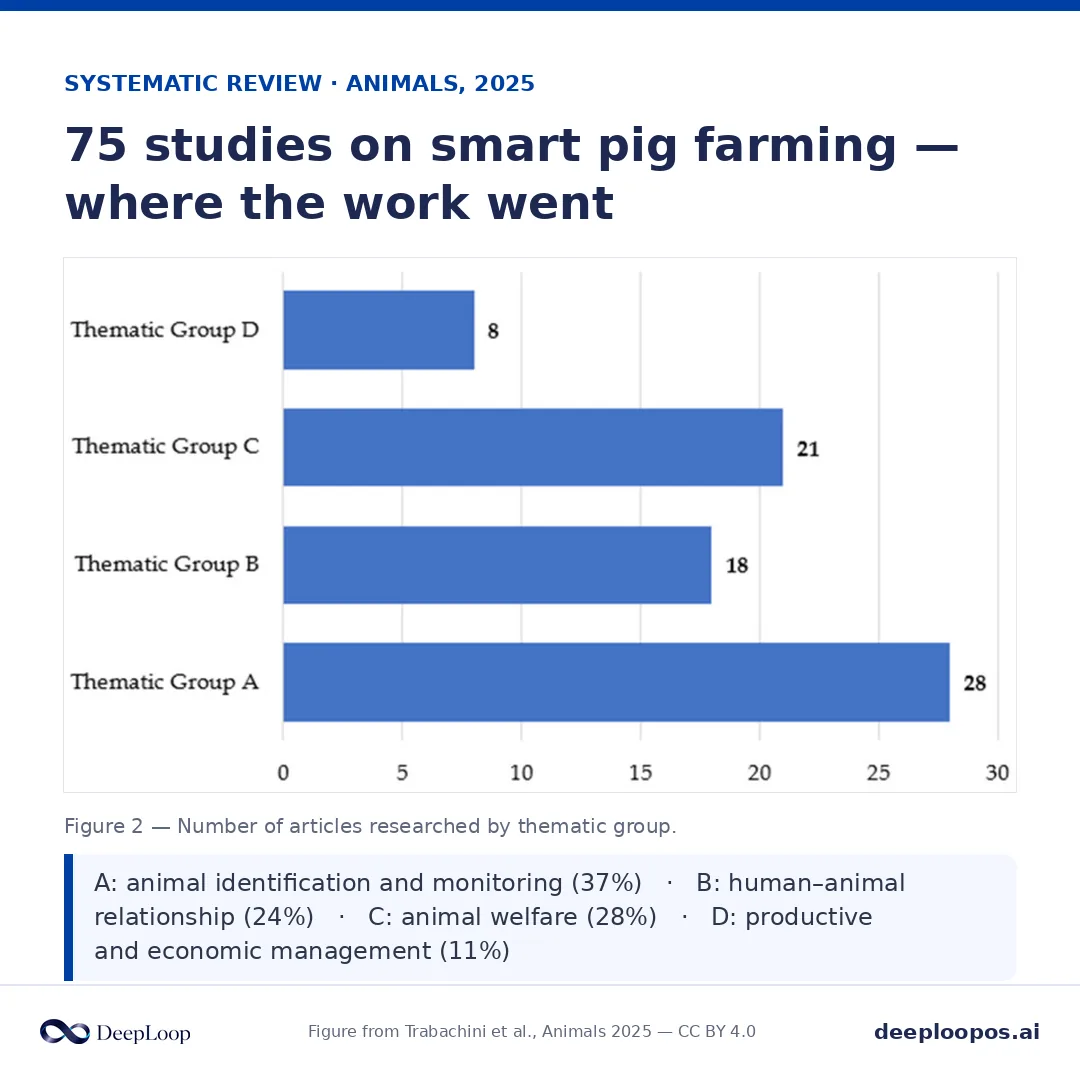
From Trabachini et al., Animals 2025 (CC BY 4.0) - camera-based monitoring appeared in only a fraction of the reviewed swine studies.
What to check on your farm
The practical test costs nothing. Crouch to pig level at the back of the pen, where the animals rest, and check the air there - not at the sensor over the alley. Do it when the pigs are lying down, not when a walkthrough has just stirred them up. If the litter under the covers is damp, if there's a bite of ammonia at floor level that the panel never shows, the reading you trust is measuring the wrong air. The number the guides agree on is only as good as the place you take it.
Where this is heading
Farms today run a gas sensor here, a temperature probe there, a camera for security - three systems that never talk to each other, and a stockperson left to join the dots on a walkthrough. That's the gap the 2025 review named: signals that stay separate. DeepLoop is building toward the integrated side of it - behaviour and environment read together, continuously, on every pen, so the limit these sources agree on gets held between inspections, not just known.