DeepLoop Team · 2026-10-05
Layer Rearing: The Rearing House Sets the Laying Life
A hen's whole laying life is largely decided before she lays a single egg - in the rearing house, by whether she hits her body-weight curve. She arrives at point of lay on the curve, or she arrives light, late and uneven, and everything after is consequence.
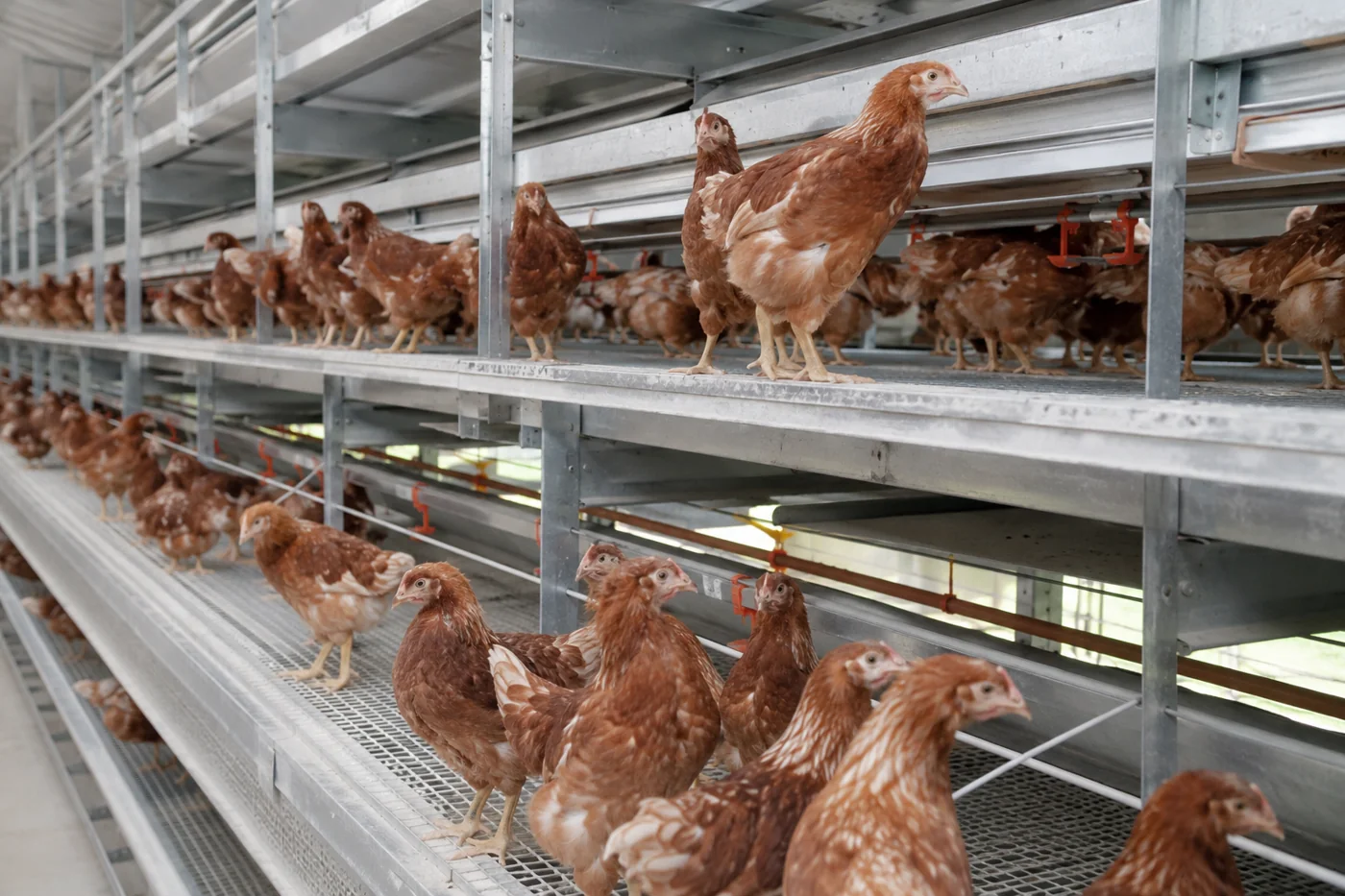
Weight, not age, runs the programme
Lohmann prints a target weight for every week of rear. By 17 weeks an LSL-Lite pullet should be about 1.26 kg and a Brown-Classic about 1.42 kg. The bird either arrives at point of lay with the right frame and reserves, in step with her flock, or she arrives behind. Lohmann is explicit that the diet switches on body weight, not age - 'weigh at regular intervals' - so every diet change is triggered by a weighing, not a calendar date.
Is it one flock, or three?
The two things that actually matter in rear are ones a silo can't tell you: is the flock the right size, and is it one flock or three? Uniformity - measured as CV% and the ±10% band - decides whether a diet change lands on the whole flock or splits it. The pre-lay bridge exists partly to pull a spread-out flock back together before lay. Neither works on a headcount average; both need the spread, not the mean.
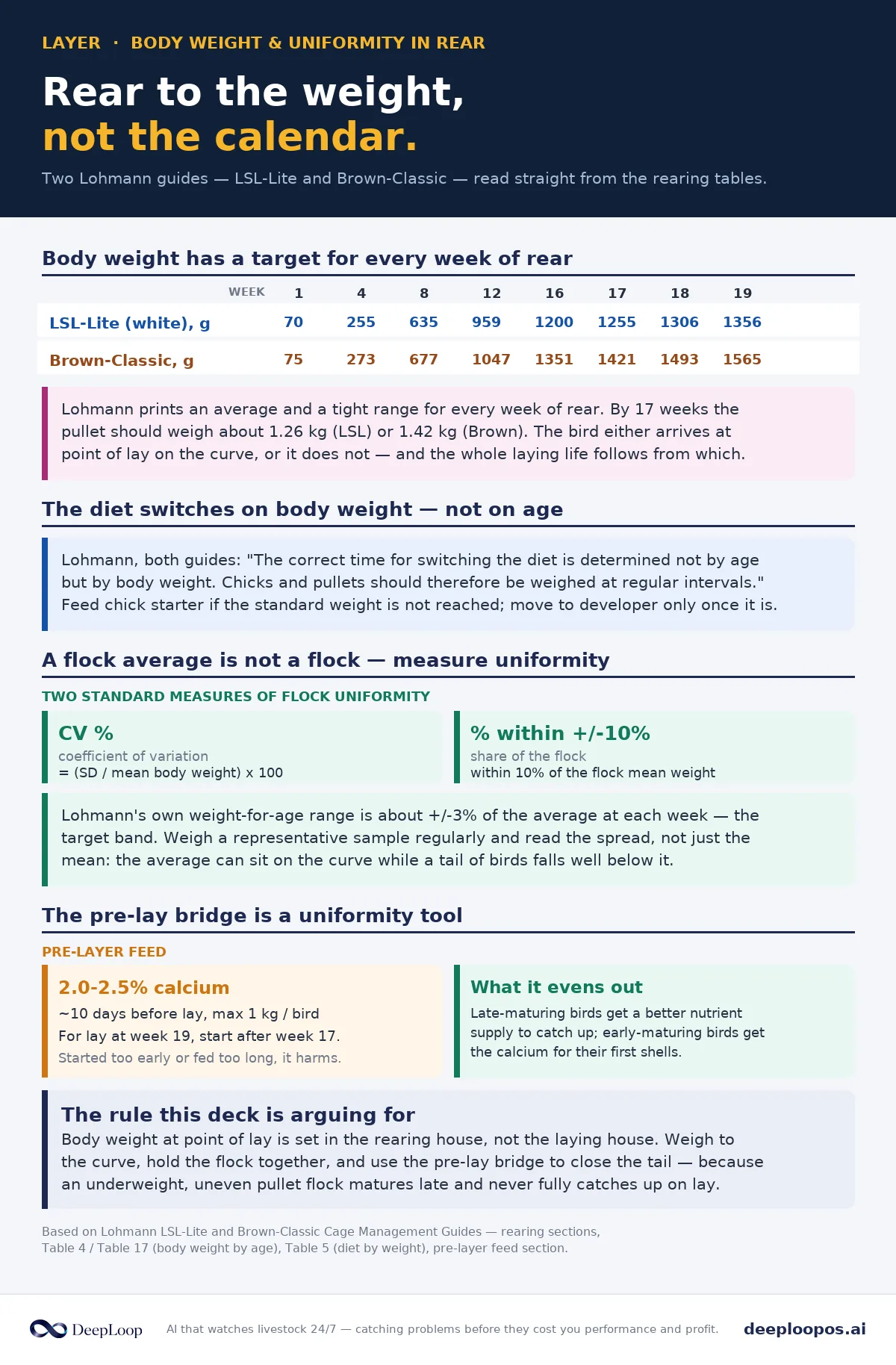
LSL-Lite and Brown-Classic body-weight-for-age curves through rear, redrawn from Lohmann.
The weight came back, the eggs did not
A Chinese team asked a hard question: if a pullet is light at the end of brooding but later catches up in weight, is she fine, or is the early deficit permanent? They sorted 640 Hy-Line Brown pullets at 6 weeks into a normal group and a group 25% lighter, then reared and laid both on identical feed to 72 weeks. The light group's body weight recovered - but the early deficit left a lasting mark on production. Catching up on the scale did not fully catch up on the belt.
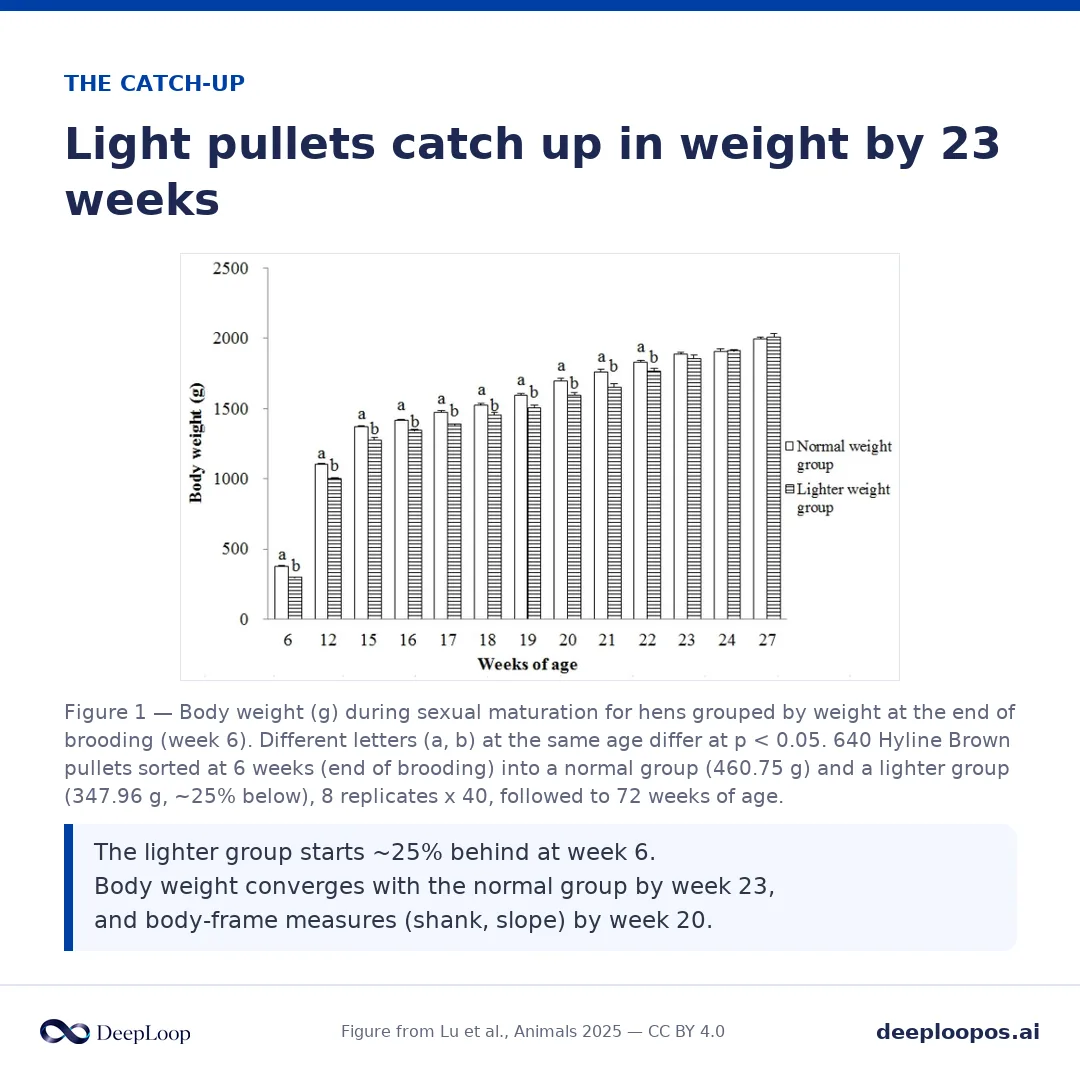
From the early-deficit study - pullets that were 25% light at 6 weeks recovered weight but not full lifetime production.
Read the spread, not the average
A rearing flock weighed as an average hides the tail - the light birds that will come into lay late and never fully close the gap. Uniformity is the number that decides whether point of lay lands on a flock or a spread, and the window to fix it closes as lay begins. Weigh enough birds to see the tail, not just the mean.
Where this is heading
The number underneath all of it is what each individual bird weighs, read often enough to see the tail before point of lay closes the window. DeepLoop is working on exactly that - turning an occasional sample weigh into a continuous read of the spread.