DeepLoop Team · 2026-11-02
Broiler Water Quality: The Biggest Input, the Least Tested
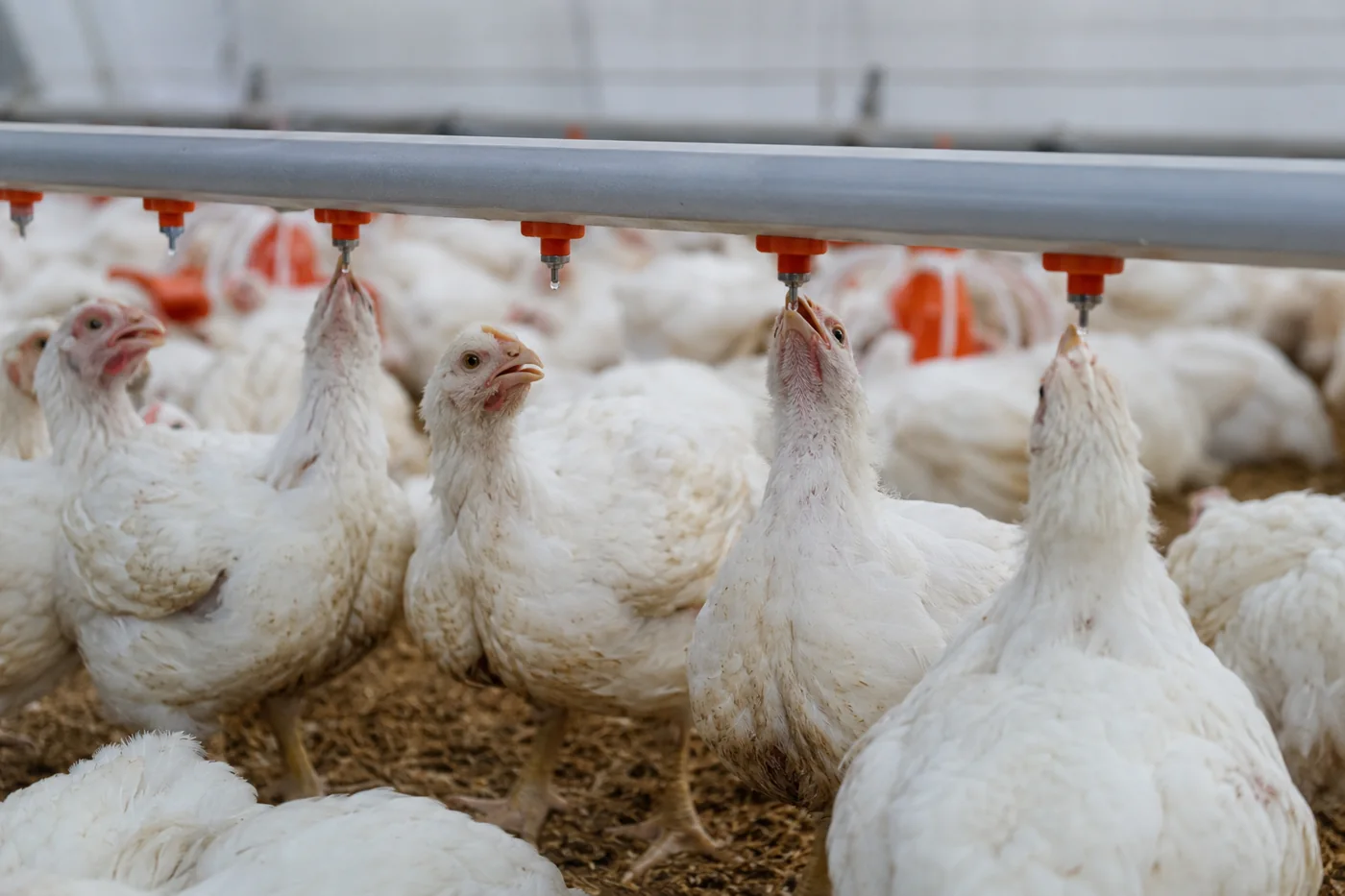
A broiler drinks more water than it eats feed. At 21 °C a healthy flock takes 1.6-1.8 litres of water for every kilo of feed, rising about 6.5% for each 1 °C above that - yet water is the input most farms measure least.
ORP is the number both breeders trust
Two independently written handbooks - Ross 2025 and Cobb 2021 - disagree on plenty, but they land on the same sanitation pass-mark to the millivolt: ORP at least 650 mV. That reading measures the sanitizer's actual activity, not the ppm you dosed. It is the one water number the two guides agree on, which is exactly why it is the one to trust.
The ppm can lie
Ross calls water pH 6.5-8.5 'satisfactory' for the bird - but active chlorine (HOCl) collapses right across that band: 90% active at pH 6.5, 72% at 7.0, just 21% at 8.0. A pH that is comfortable for the bird can be a pH where your sanitizer has quietly died. It is why Cobb runs chlorine at pH 5.0-6.5, and why 3-5 ppm at the drinker means nothing without the pH beside it.
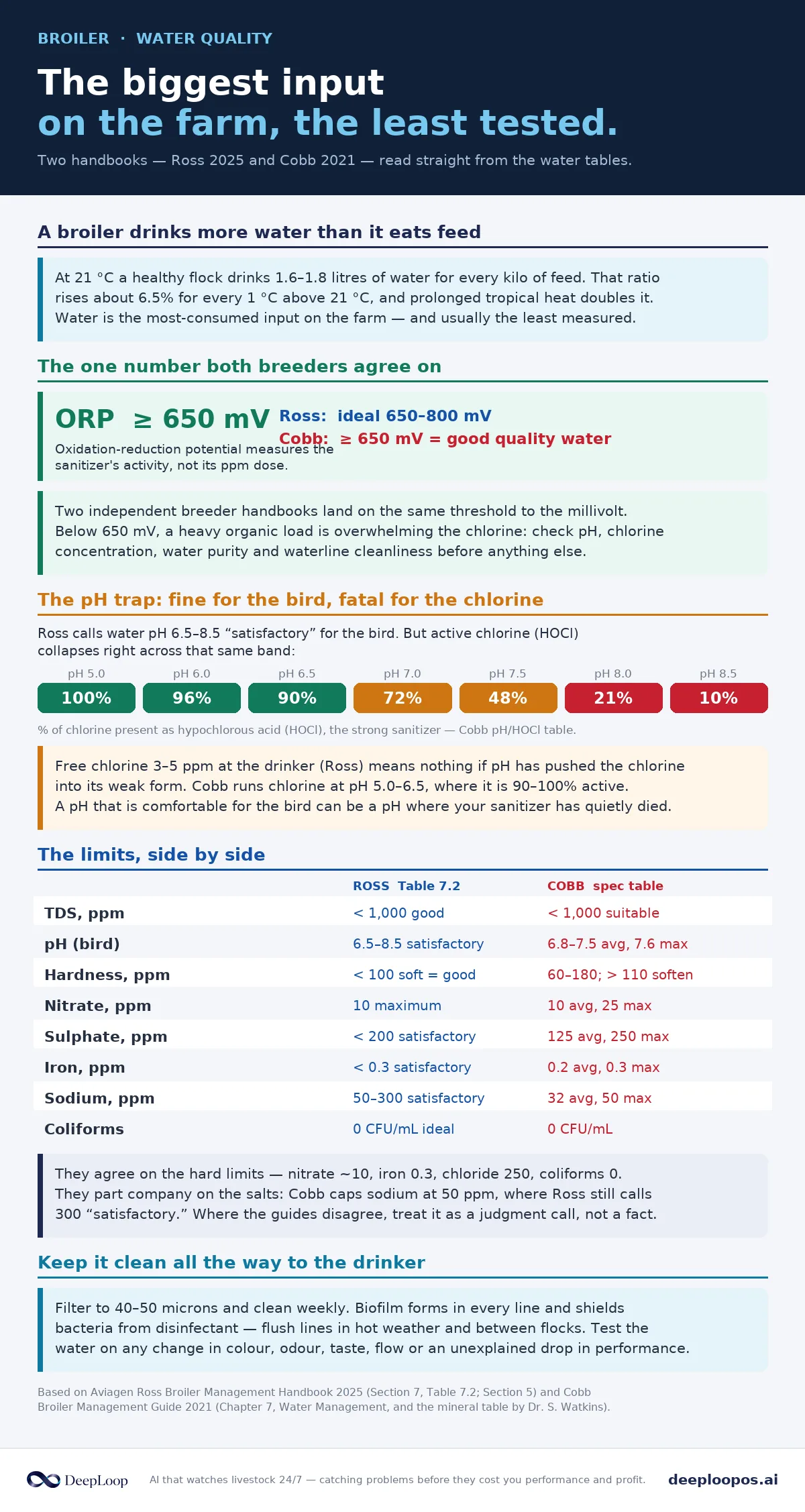
The Ross-vs-Cobb water limits and the shared ORP ≥ 650 mV pass-mark, redrawn from both handbooks.
Same chlorine, cleaner gut
A team in China tested the idea in live broilers: one group on ordinary distilled water, the other on the same water dosed with a low ~1 mg/L of hypochlorous acid held at pH ~6.0, for the full 42 days, nothing else changed. Held at the pH where the active form dominates, the low dose improved gut condition - evidence that it is not the ppm but the active fraction, set by pH, that does the work.
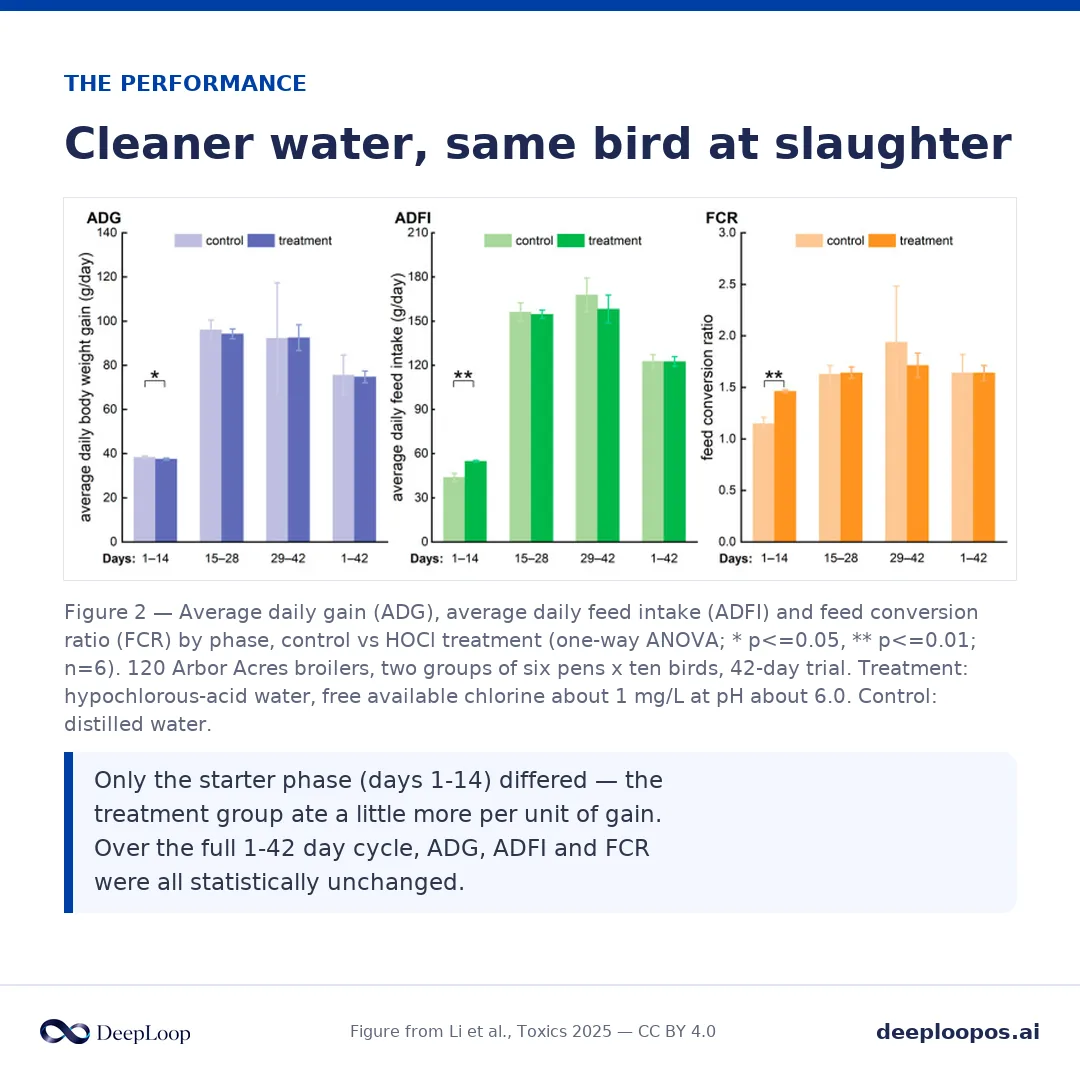
From the broiler study - a low hypochlorous-acid dose held near pH 6 improved gut condition over plain water.
Trust where they agree, judge where they differ
The water:feed ratio is a free early-warning - a drop signals a problem before the flock shows it. ORP is the one agreed number to trust; the pH/HOCl curve is why the dose on the pump is not the sanitizer at the drinker. Where Ross and Cobb agree, trust it; where they differ, judge it - and back both with line-flushing and a biofilm check.
Where this is heading
DeepLoop is working on the part nobody watches - what actually reaches the drinker, continuously. The dose on the pump is an intention; the ORP at the drinker is the truth, and only one of them is usually measured.