DeepLoop Team · 2026-08-31
Broiler Lighting: The Dark Hours Are Doing the Work
The oldest instinct in a broiler house is to keep the lights on - more light, more feeding, more gain. Both major breed manuals say the opposite: the darkness is a management tool, and taking it away costs you market weight.
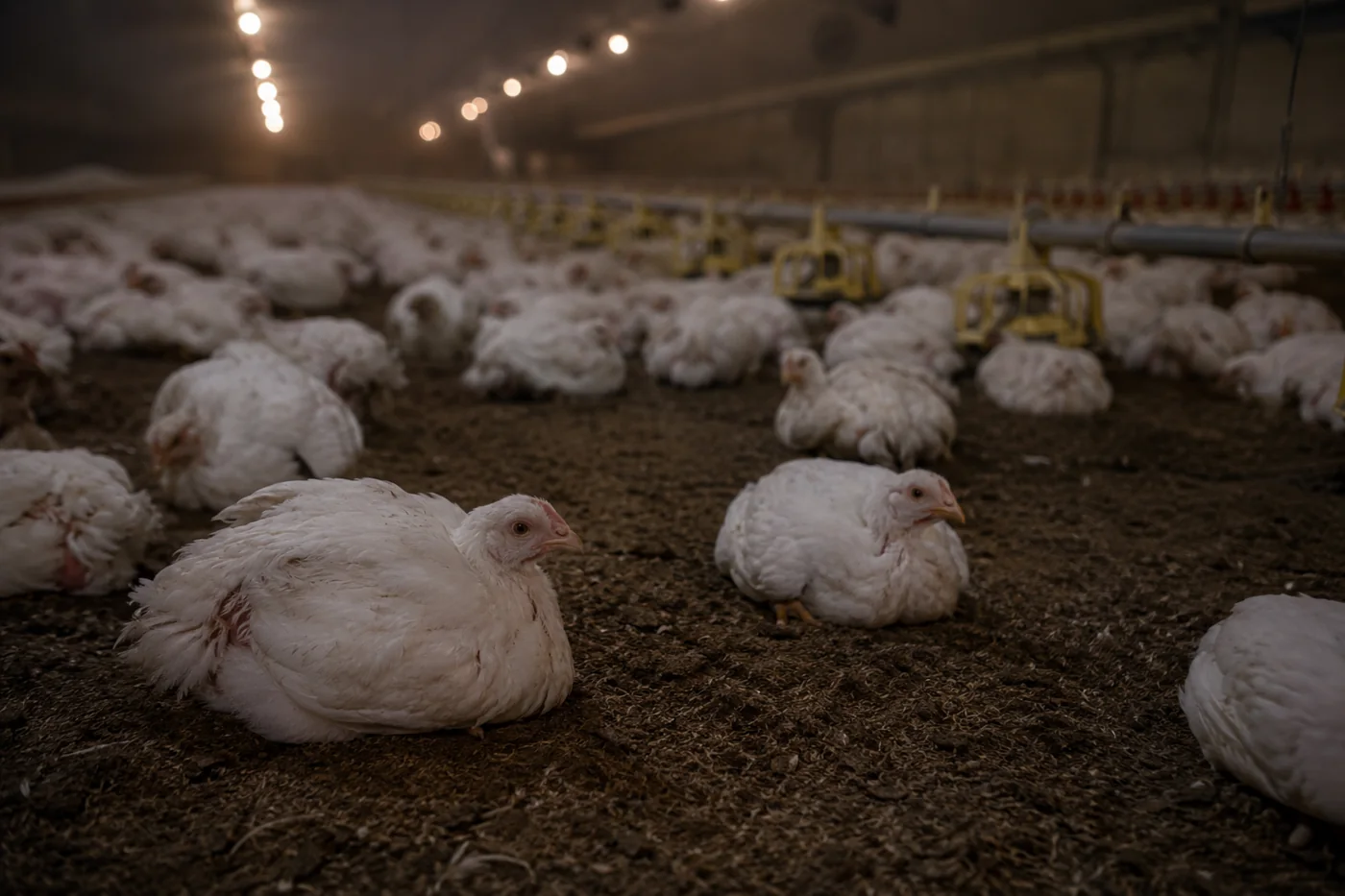
Darkness is not idle time
Aviagen states it plainly - continuous or near-continuous lighting does not raise market weight, it depresses it. A defined light-and-dark cycle is what lets the bird lay down late growth, leg strength and breast yield. The dark hours are when the metabolic and skeletal work happens; take them away and you take the gain with them.
Ross and Cobb set the night differently
They do not set the dial to the same place, and that is the part worth reading. Aviagen's general programme caps the dark at a 4-6 hour floor - a minimum of 4 hours continuous darkness after day 7. Cobb ties the dark period to slaughter weight instead: 6 hours for a bird under 2.5 kg, 8 hours at 2.5-3.0 kg, 10 hours over 3.0 kg, then stepped back down one hour at a time before catching. Same principle, two different depths of night. Where they agree: brood bright (Ross 30-40 lux, Cobb 25 lux minimum), dim to 5-10 lux once birds hit 130-180 g but never below 5, one continuous dark block never split, and light nudged brighter before catch to keep the flock calm.
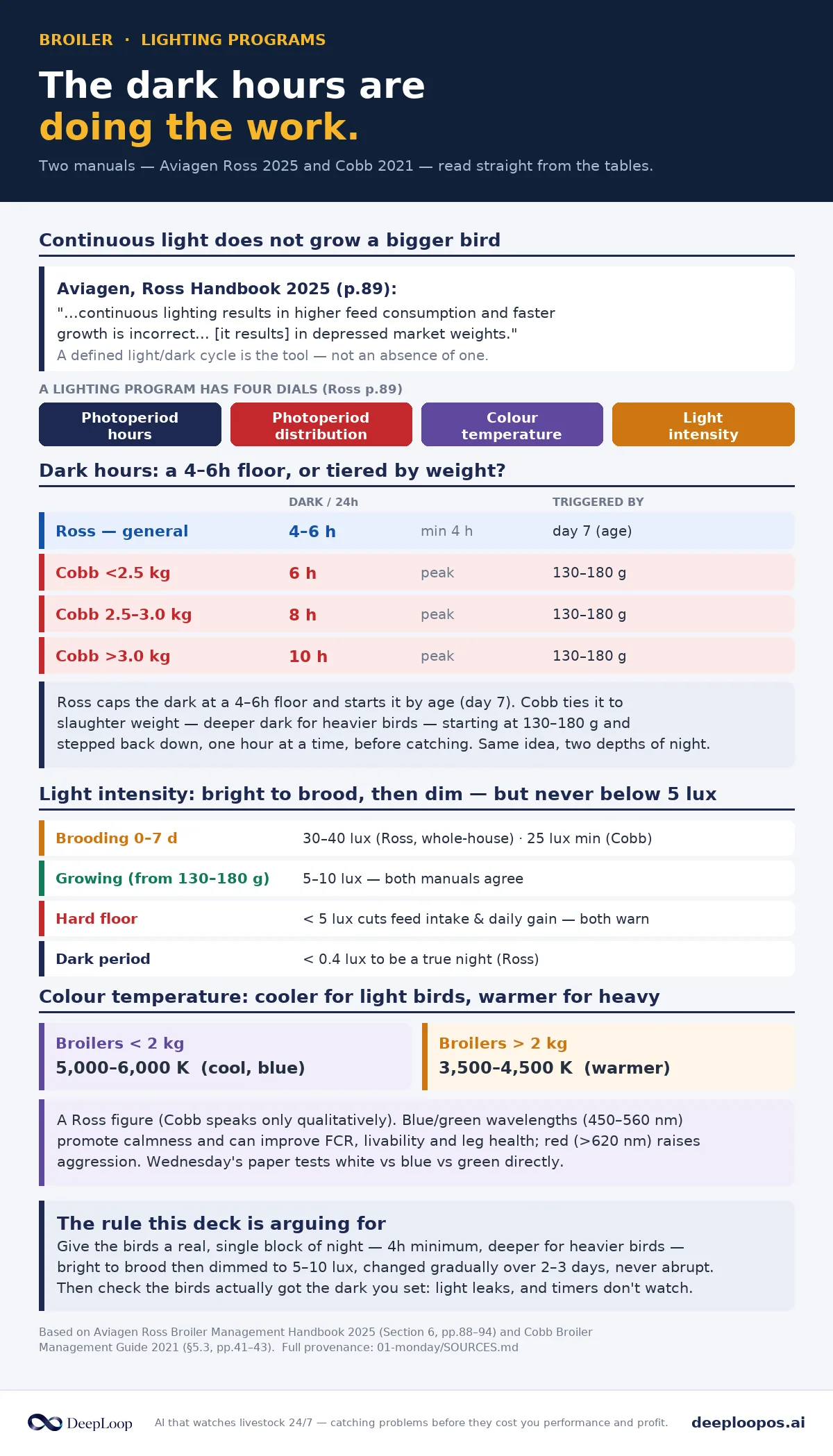
Ross vs Cobb dark-hours schedules and lux targets by age, redrawn from the Ross 2025 handbook and Cobb 2021 guide.
Light colour: a welfare dial, not a growth shortcut
Ross states there is no strong evidence one bulb colour grows a bigger bird. A US team tested it: 600 Cobb 500 broilers raised to processing under broad white, monochromatic blue (450 nm) and green (560 nm) at the same low intensity. Growth did not care - final body weight (3.30-3.32 kg) and feed conversion (1.57-1.59) were statistically the same across all three colours. What changed was behaviour: green-light birds were the most active, especially early (261 vs 200 m/s² for white at two weeks), with activity fading as they aged. Colour is a behaviour and welfare tool, not a growth shortcut.
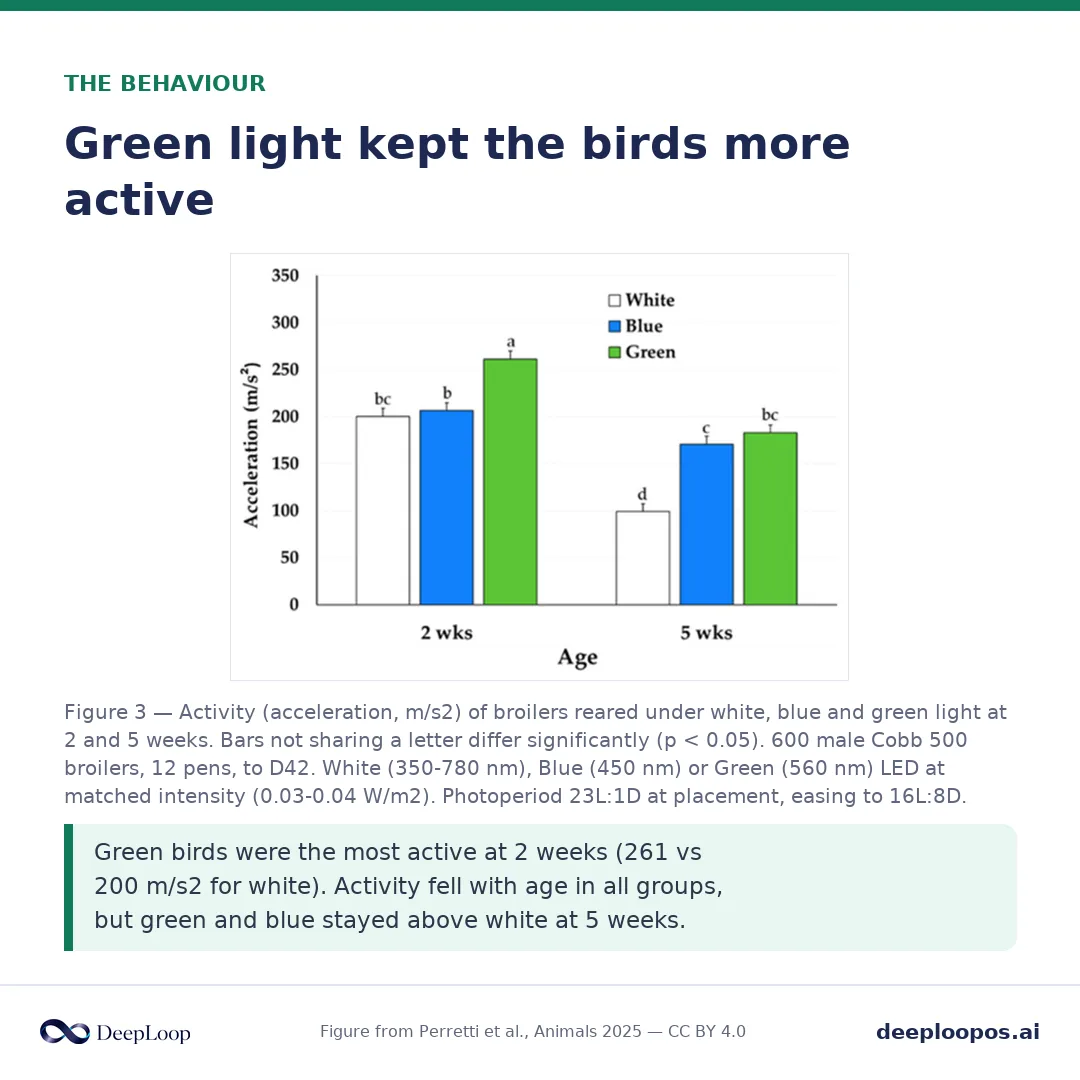
From the light-colour study - final weight and FCR were unchanged across white, blue and green; behaviour and activity differed.
The gap the timer cannot see
A lighting programme is a schedule of intentions. Whether the birds are actually resting in the dark you scheduled - or being kept awake by light leaking through an inlet - is invisible to the timer. Intermittent beats continuous only if the dark block is genuinely dark; a house that reads 'lights off' while daylight leaks in is not giving the birds the night the programme promised.
Where this is heading
The controller sets the hours; the birds live them. DeepLoop is working on the gap the timer can't see - whether the flock is actually resting in the dark you scheduled, so the programme on paper is the one the birds get.