DeepLoop Team · 2026-10-12
Broiler Uniformity: The Average Weight Is Lying to You
Two broiler flocks can hit the exact same average weight on kill day and pay out completely differently. The difference is the spread - and it has a number: CV%.
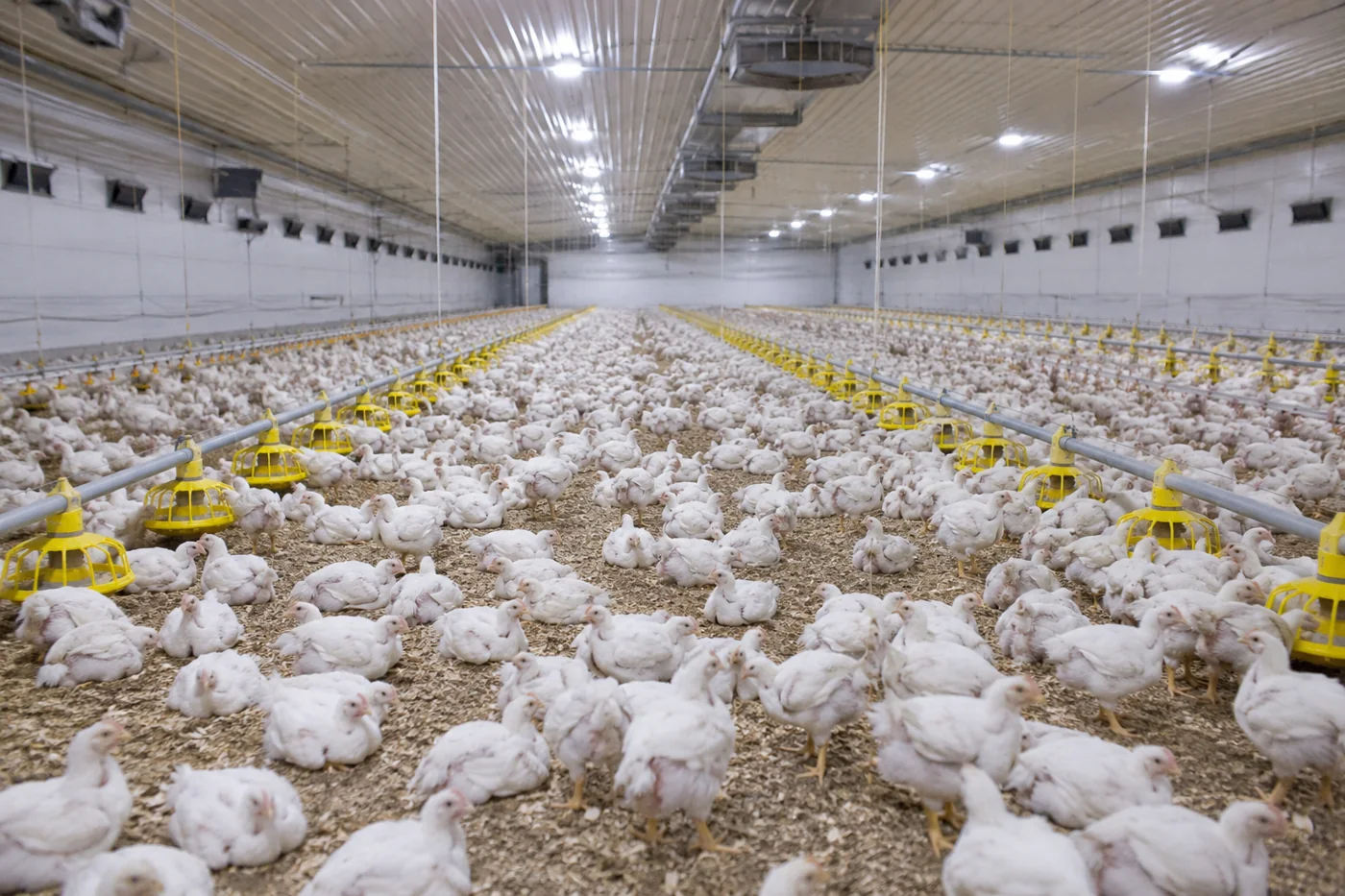
One curve, two breeders
CV% is the standard deviation of body weight divided by the average - the lower it is, the tighter the flock. Ross and Cobb publish nearly the same conversion: CV 5 means 95% of birds sit within ±10% of the average; CV 10 means 68%; CV 12 means barely 60%. Two independent breeders, one curve - they differ on a single row (CV 12: Ross 60%, Cobb 58%).
The spread is money, not neatness
Take a flock averaging 1.9 kg. In a tight 1.8-2.0 kg pay band, a CV 8 flock lands 58% of birds in the band - a CV 12 flock only 41%. Same average weight; seventeen fewer birds in every hundred getting paid at target. Every bird outside the band is discounted, downgraded, or grown on at extra cost. And it is decided early: chicks arrive at about CV 7.9 - 80% uniform - and the first week either holds that or loses it. Ross wants 7-day weight at least 4.5x day-old; Cobb asks 4.8x. Miss it and the flock rarely closes the gap.
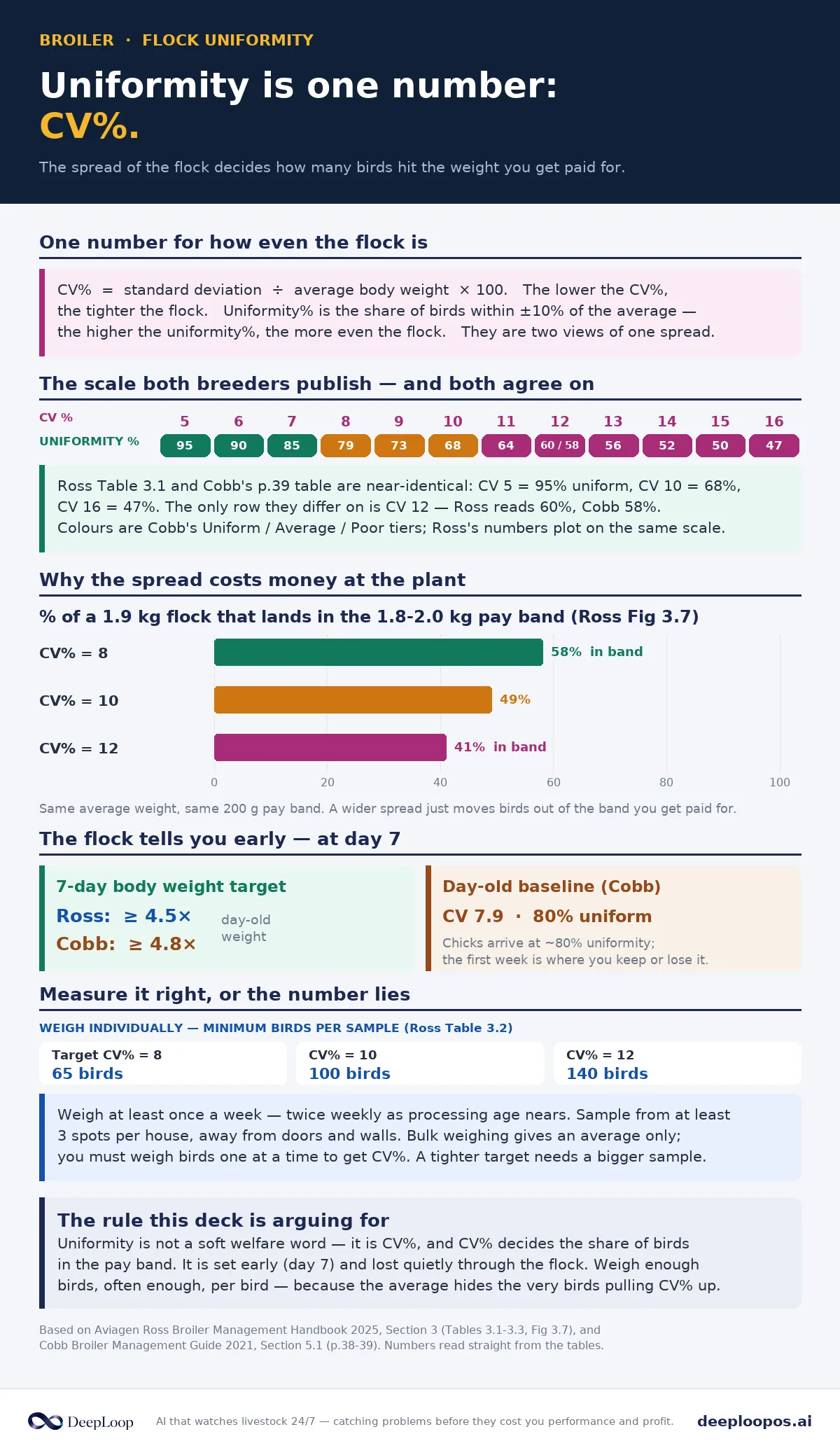
The CV%-to-uniformity scale both breeders agree on, with the ±10% band, redrawn from Ross and Cobb.
Every stress leaves the same mark
A 2026 review in Animals pulled together 13 broiler studies and asked what pushes a flock off uniform. The answer: almost everything does, but not equally. Heat, crowding, mash feed, a disease challenge - each cost a flock only a few points of uniformity, real but small, around -2 to -5 points apiece. The lesson is that uniformity is lost in small increments from many directions, which is why it has to be protected continuously rather than fixed after the fact.
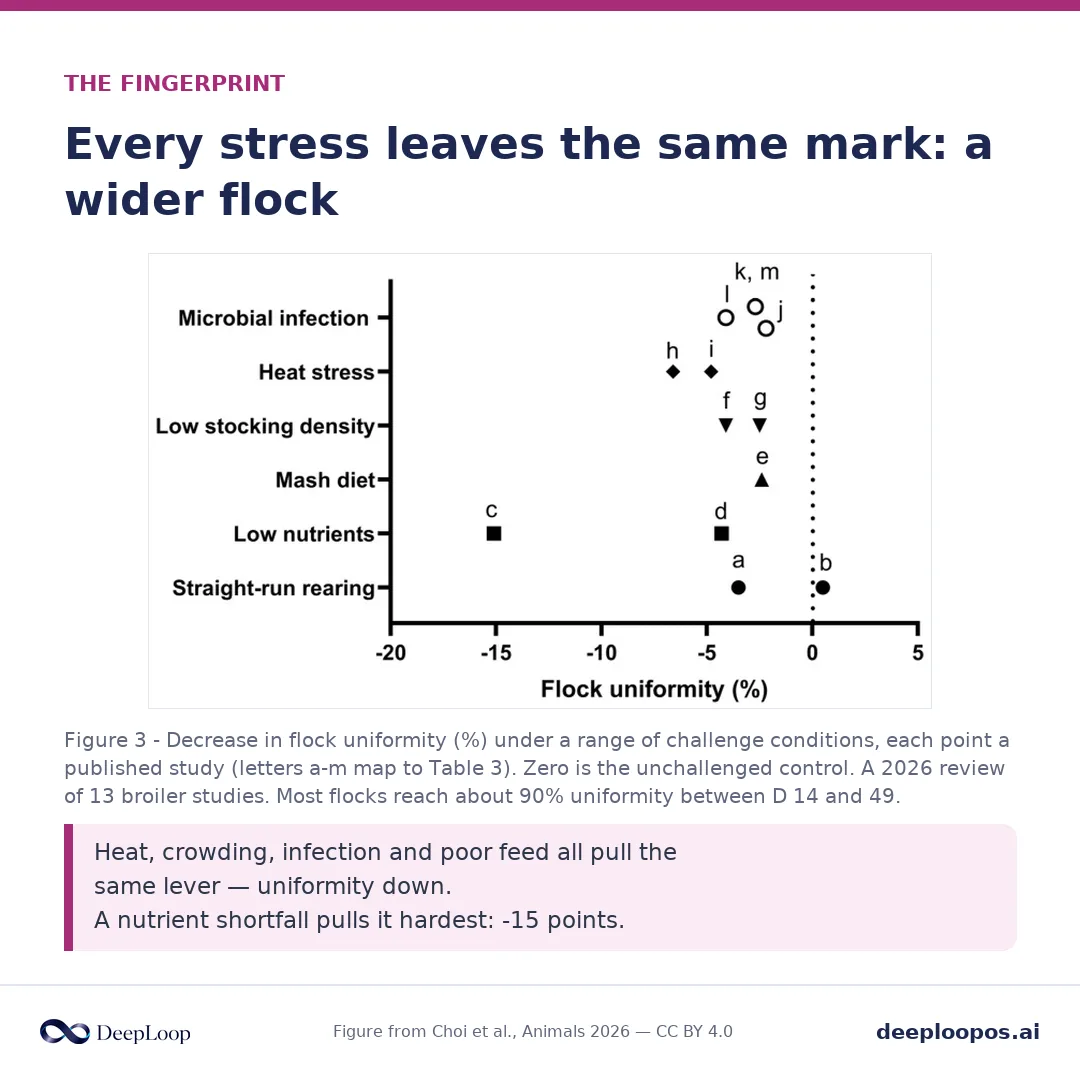
From the 2026 review - individual stressors each cost a broiler flock only a few points of uniformity; they add up.
An honest number needs enough birds
CV% is only as honest as the sample behind it. Weigh too few birds and the number is noise; the reference sets a minimum sample for a trustworthy figure. And a weekly weigh-in is a dot once a week on something that moves every day - the spread can widen between weighings and never be seen until the plant reports it back.
Where this is heading
DeepLoop is working on the part the weekly weigh-in misses - each bird's weight, read continuously, so CV% is a live line instead of a dot once a week. The average will always look fine; the spread is where the money is won or lost.